SOC, Pentest or GRC? How to Choose Your First Cyber Role
The main roles in security, what people actually do all day, how to pick one, and why I'm starting at help desk.

"Cybersecurity" is not one job. It's a whole industry, and the people in it spend their days doing very different things. Some watch screens for attacks. Some break into systems on purpose, with permission. Some write policies and never touch a terminal (the text window where you type commands). If you don't know that, it's easy to spend months learning for a role you wouldn't enjoy.
This post is the map. By the end you'll know the main roles, what they involve, and how to decide where to aim. I'll also explain why I'm taking a route that is less common for beginners.
The big picture: blue, red and everything else
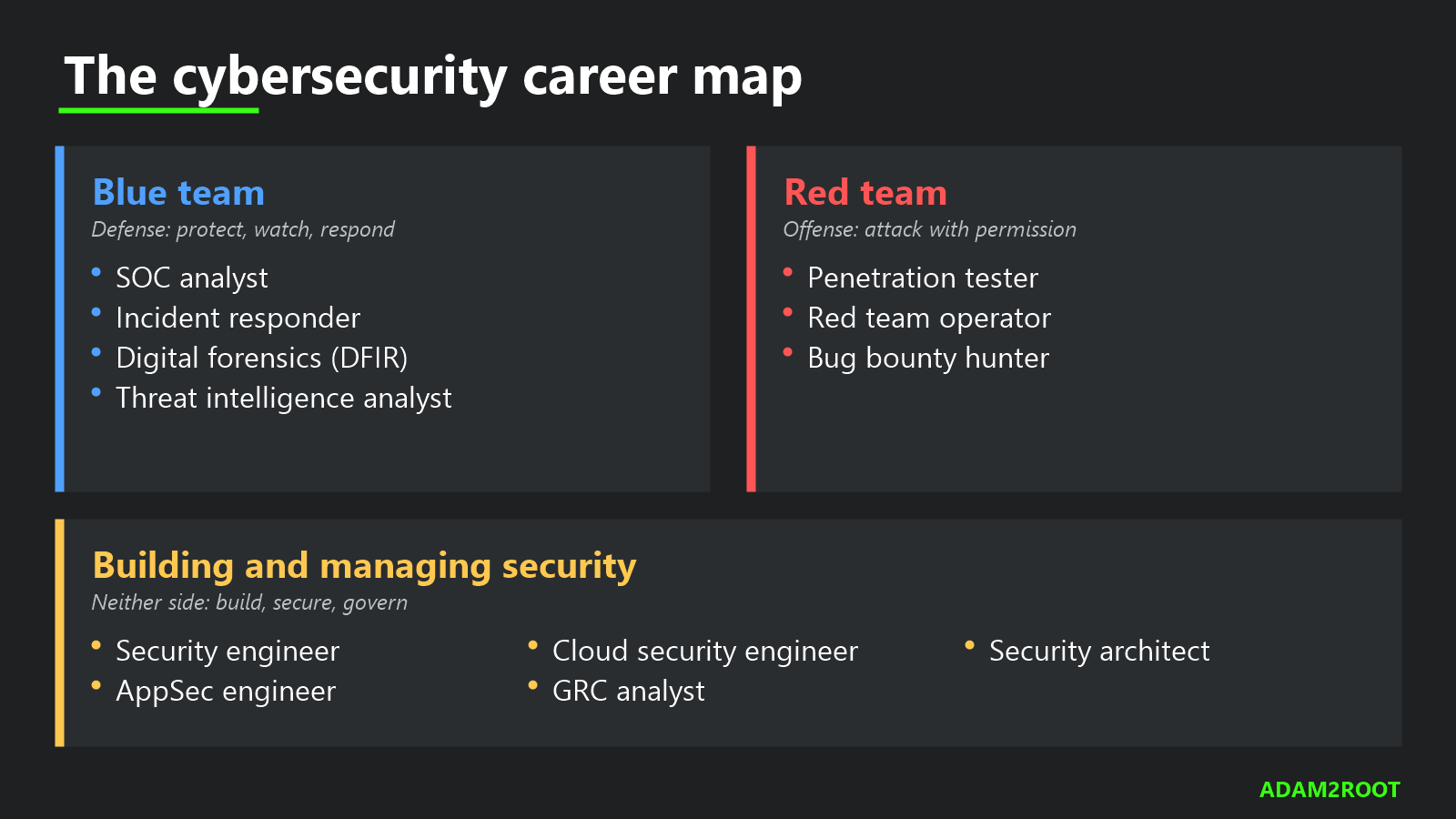
Security work is often split into two sides.
- Blue team is defense. These people protect systems, watch for attacks, and respond when something goes wrong.
- Red team is offense. These people simulate attackers, with permission, to find weaknesses before a real attacker does.
A lot of roles don't fit either color neatly. They cover rules, risk, building secure systems, and investigating incidents. I've grouped everything below.
Defensive roles
SOC analyst (Security Operations Center). You monitor alerts from security tools, decide which ones are real attacks, and escalate the serious ones. It's one of the most common entry-level security jobs, and it often involves shift work. You'll spend a lot of time looking at logs, the records computers keep of what happened on them.
Incident responder. When a breach happens, you contain it, work out what the attacker did, and help the company recover. It's usually a step up from SOC work, and it's often stressful.
Digital forensics (the "DF" in DFIR, Digital Forensics and Incident Response). You investigate computers and networks after an incident to find out what happened, and you preserve evidence carefully. Useful in companies and in law enforcement.
Threat intelligence analyst. You research how attackers operate, who they target, and what that means for your organization.
Offensive roles
Penetration tester. You're hired to attack a company's systems, with written permission, and then report what you found and how to fix it. Web applications, networks, mobile apps and cloud setups are all common targets. Writing clear reports is a large part of the job.
Red team operator. Like a penetration tester, but with a longer, stealthier engagement that tests the defenders as well as the systems. It usually requires several years of experience first.
Bug bounty hunter. You look for vulnerabilities in companies that invite outside researchers to test their products, and you're paid when you report a valid one. It's often freelance, the income is unpredictable, and the competition is high.
Building and managing security
Security engineer. You set up and maintain security tools and make systems harder to attack. It's closer to IT and software work than to hunting threats.
Application security (AppSec) engineer. You work with software developers to find and fix security problems in code before the product ships.
Cloud security engineer. You secure systems running on platforms like AWS, Azure and Google Cloud.
GRC analyst (Governance, Risk and Compliance). You check that the company follows laws and standards, assess risks, and write policies. It involves little hacking, and it's a good fit for people who like process and documentation.
Security architect. You design how security fits into a company's whole technology setup. This is a senior role that usually comes after years in other jobs.
How the roles compare
| Role | Day to day | Good fit if you like | Common way in |
|---|---|---|---|
| SOC analyst | Reviewing alerts and logs | Patterns, routine, working in a team | Entry-level, often straight after study |
| Penetration tester | Attacking systems, writing reports | Puzzles, breaking things, writing | Often after an IT or security job, or strong proof of skill |
| Bug bounty hunter | Hunting bugs alone | Independence, persistence | Anyone can start, few earn a living early |
| Security engineer | Building and tuning defenses | Systems, automation | After IT, sysadmin or developer experience |
| GRC analyst | Policies, audits, risk | Structure, documents | Business, audit or IT background |
Pay varies a lot by country, company and level, so check job listings in your own area to see what's realistic. I'm not going to quote numbers here that might be wrong for you.
The usual beginner route, and the one I chose
The entry point most people recommend to beginners is a SOC analyst job. Companies hire for it at entry level more often than for most other security roles, and the skills carry over to many others. That's why SOC is usually the first step into the cyber industry, and a stepping stone to other roles once you're in.
I'm choosing a different route: help desk first, then penetration testing.
Before deciding, I watched a lot of videos about security careers and read a lot of job listings. What I took from them is that three things get you hired: soft skills, experience working with real systems, and real penetration testing skill.
I believe that what gets you hired for offensive security is proof that you can actually do penetration testing at a high level, more than a background in defense. The road to a beginner SOC job may be easier and shorter than the road to pentesting, but it still means learning a lot of skills and knowledge. So I decided to put my time into the thing I'm passionate about, which is attacking. Help desk gives me much of the same foundation as SOC work, while leaving me free to focus on what I really want.
My reasons, in more detail:
- Help desk teaches the foundation. Users, permissions, networks, Active Directory (the Microsoft system most companies use to manage user accounts and computers) and troubleshooting are the same things a pentester has to understand. I'd rather learn them while being paid.
- It's a safer start. A help desk job pays, and it makes my resume more credible. I can build penetration testing skills on the side without needing them to pay yet.
- Entry-level pentest jobs are rare. Companies that hire pentesters usually want proof that you can work in real environments. Help desk gives me that experience, and my own lab work builds the pentesting skill.
There's a real cost. This route is probably slower, and the SOC route is a more direct way into a security job. If you don't care about offensive work, SOC may well be the better choice for you. I'm not claiming my route is better, only that it's the one that fits what I want.
How to choose your own path
Ask yourself these questions:
- Do I like finding out how something works, or making sure it keeps working?
- Do I prefer solo problem solving or working in a team?
- Am I happy with shift work, repeating tasks and long periods of watching?
- Do I enjoy writing and explaining things clearly? Almost every role requires it.
- How soon do I need a paid job? That should weigh heavily in the decision.
You don't have to pick a final answer today. For the first few stages of this course, the skills are the same whichever role you choose.
If you want to dig deeper, CyberSeek's career pathway is a free interactive map of US cybersecurity jobs. It shows the roles, job-listing data and salaries, and how people move from one role to the next.
Your exercise
- Pick the one role from this post that interests you most.
- Find out what the job looks like day to day. Read a short article about it, or search YouTube for "day in the life of a SOC analyst" (or whichever role you picked) and watch one or two videos.
- Open a job site such as LinkedIn Jobs or Indeed and read five listings for that role.
- Write down the skills, tools and certifications that show up again and again. Put a mark next to the ones you already have.
- Keep that list. We'll come back to it when we talk about resumes and LinkedIn.
If a second role also caught your interest, do the same for it and compare the two lists.
Here's what that looks like. These are the requirements from three real US listings for junior penetration testers, copied word for word with the company, salary and date removed.
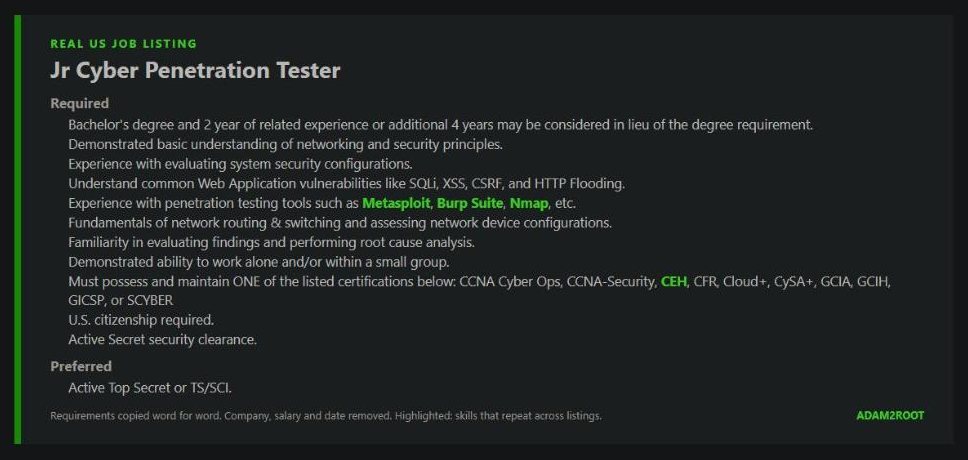
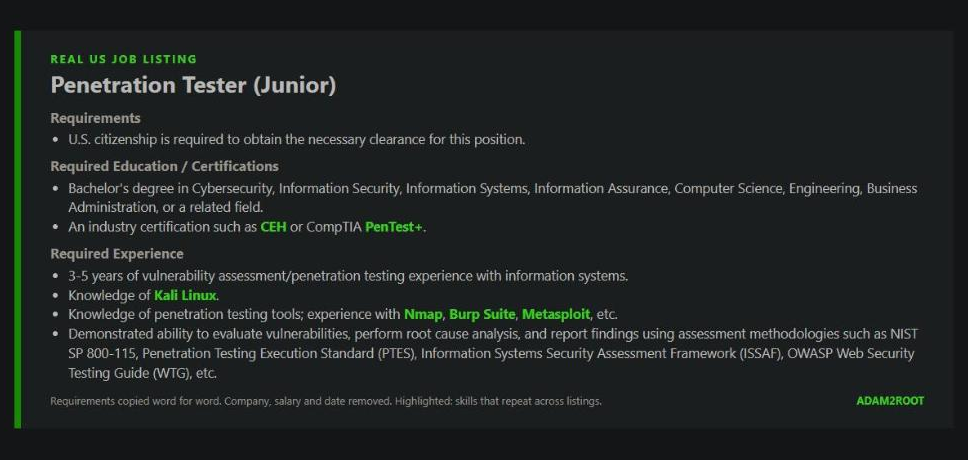
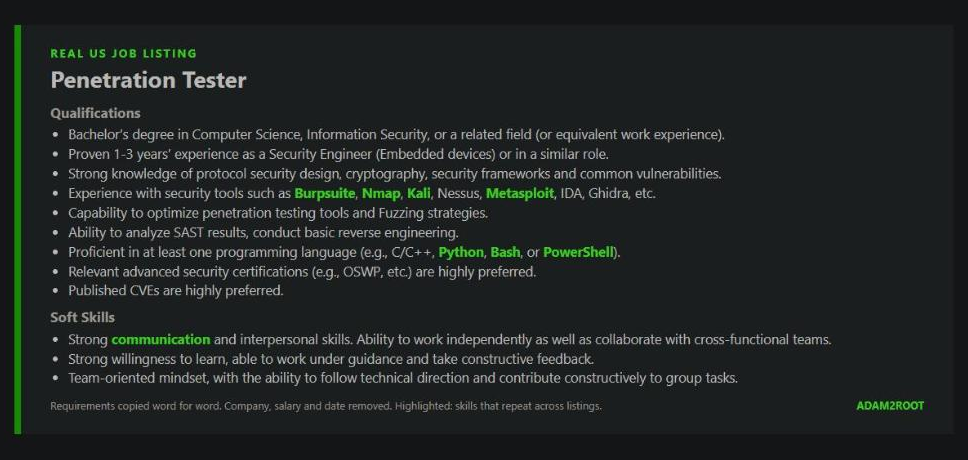
Look at what repeats. All three ask for Nmap, Burp Suite and Metasploit, which are tools for scanning networks, testing web apps and running exploits. Two of them name the CEH (Certified Ethical Hacker) certification, and two require US citizenship for a security clearance, which is common for government contractors. Even with "junior" in the title, they ask for between one and five years of experience. The third listing also has a whole section on soft skills: communication, teamwork and taking feedback.
Don't let that scare you off. It shows you what to build toward, and it's part of why I'm starting at help desk: it's paid experience with real systems and real users while I build the pentesting skills on the side.
What's next
The next post is about how to learn all of this so it sticks. If you've tried courses before and forgotten them a week later, it's for you.
Comments
Join the discussionNo comments yet. Be the first to comment.
Adam2Root: Help Desk to Hacker
A free, step-by-step path from zero IT knowledge to a first help desk job, and from there toward penetration testing. Written by someone learning it one step ahead of you. Read the posts in order.